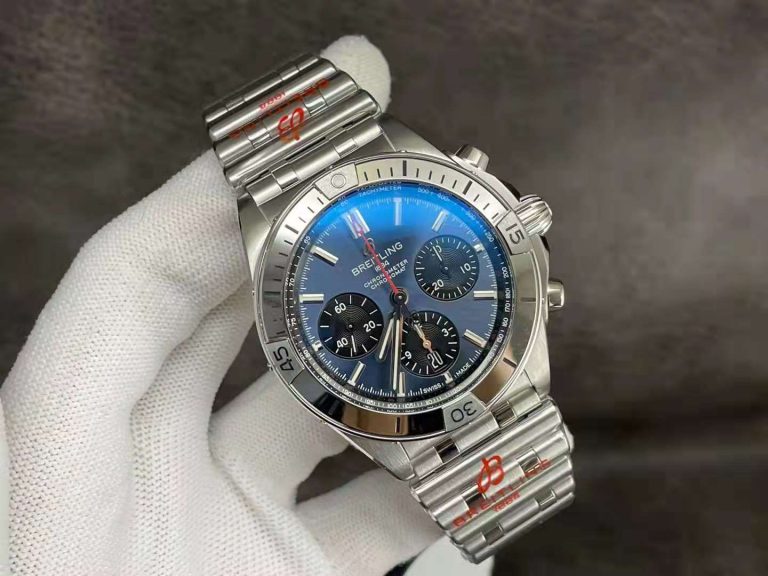
The blue dial is a useful test of chronograph balance: subdials must remain clear without splitting the dial into unrelated pieces.
The Chronomat identity is unusually dependent on parts that are not the dial. Its rider tab bezel, crown guards and rounded bracelet links establish a structural rhythm. If the bracelet joins the case awkwardly, a carefully printed chronograph face will still feel disconnected.
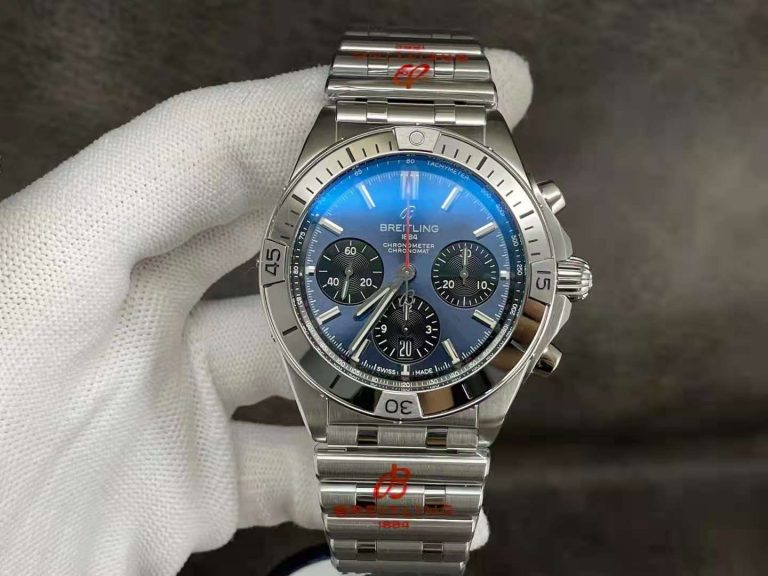
It appears that GF has expanded its scope, now able to provide high-quality replica watches encompassing a wider range of Swiss brands. However, rest assured that the COVID-19 cases are limited, and the situation is under control, with only a few cases reported. The recently launched Breitling Chronomat boasts a 42mm diameter and features a case thickness of 14.5mm. The replica watch is constructed using solid stainless steel for the case, bezel, and bracelet. The brushing and polishing finish on both the case and bracelet are commendable.
When handling a well-crafted replica, the tactile experience becomes apparent, particularly when running your fingers along the corners and edges. The dial showcases a captivating blue hue, with hands and hour markers adorned with luminous material for enhanced visibility. Featuring three small dials, each functioning authentically, the small seconds hand operates on the subdial at 9 o’clock, while the remaining two small dials serve the chronograph display. The 30-minute chronograph counter is located at 3 o’clock, and the 12-hour chronograph counter sits at 6 o’clock.
The supplied description names a 7750 movement, yet that assertion calls for a movement photograph or service documentation, not merely printed case markings.
These details become clearer beside other articles in Breitling Chronomat. A series archive is useful here because one attractive photograph cannot show how this reference differs from the rest of the family.
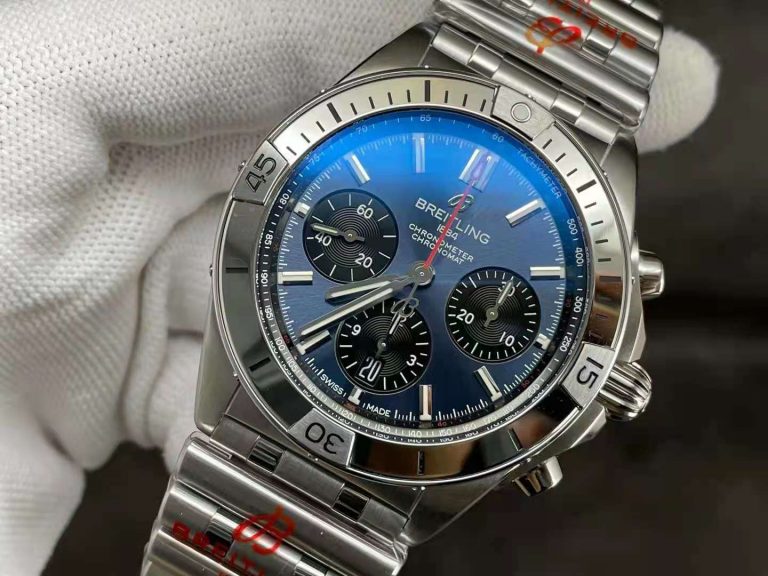
For a complicated dial, readability is the central test. Counters, calendar indications, timing scales and the basic hands should form a hierarchy that makes sense before the reader is asked to notice decorative branding. A reproduction of the text on a dial is not enough to establish that those indications function as intended.
Activating the chronograph is accomplished by pressing the button at 2 o’clock, causing the central red hand to start its movement. Pressing the button again halts the hand, and to reset it to 12 o’clock, a simple push of the button at 4 o’clock is all that’s needed. Notably, all the chronograph subdials and buttons on this replica are fully functional, ensuring the authenticity of the chronograph feature. The bracelet possesses a distinctive design, with each link resembling a bullet.
The original Breitling reference and any replica sold under a similar name must be assessed independently. A photograph may support observations about surface colour, layout and proportions; it cannot certify movement architecture, case alloy, waterproofing or long term performance.
A watch is not just the sum of named components. The minute track needs to sit convincingly with the hands, the markers should have an intentional relationship to the bezel, and the case should not appear broader merely because the dial opening is too small. This is an observable design question rather than a claim about internal specifications.
The CheapBreitlingSale editorial homepage places this reference alongside other Breitling designs with very different purposes. Seen in that context, its specific proportions are more informative than generic superlatives.
